Same-day delivery pricing typically falls between $5 and $15 for a small urban item, climbing to $20 to $50 or more for bulkier, longer-distance, or regional same-day deliveries. Businesses that run their own same-day program should budget a fully-loaded cost of $14 to $22 per order once you count carrier fees, labor, packaging, and platform costs, according to industry guidance from Online Store News.
Same-day makes sense for individuals when the item is urgent and local. For businesses, it’s worth it when your average order value can absorb a surcharge without killing margin.
- Consumer rule of thumb: if a $10 to $15 delivery fee costs less than the time or gas you’d spend doing it yourself, book it.
- Business rule of thumb: don’t offer same-day at a flat loss. Price it as a premium tier or gate it behind a cart minimum.
Your next move is simple: get a zone-based quote from a local provider, or if you’re in Nova Scotia, request a business quote from Get It Picked to see live rates for your route.
Key Takeaways
Same-day delivery pricing runs from $5 to $15 for small local jobs and $20 to $50+ for larger or longer-distance orders, while businesses should budget $14 to $22 fully loaded per order.
| Point |
Details |
| Consumer price range |
Expect $5–$15 for small urban same-day items and $20–$50+ for bulkier or regional deliveries. |
| Fully-loaded business cost |
Budget $14–$22 per order once labor, packaging, overhead, and platform fees are counted. |
| Density drives discounts |
Batching stops in the same building or neighborhood cuts per-order cost the most. |
| Compare with a normalized total |
Add every surcharge to the base fee before comparing quotes across providers. |
| Get It Picked |
Offers zone-based rates, published cutoffs, real-time tracking, and volume discounts across Nova Scotia. |
Table of Contents
How Same-Day Delivery Pricing Actually Works
Every same-day rate you see on a courier’s website or in a quote is built from one or more pricing models stacked on top of each other. Understanding these models is the difference between comparing apples to apples and getting blindsided by a total that’s twice what you expected.
Flat per-package pricing charges one price regardless of distance, usually capped to a defined service area. It’s simple, but it only works for providers with small, dense coverage zones.
Zone or distance-based pricing is the most common structure among local couriers. You pay a base fee for zone one, then an incremental charge for each additional zone you cross. Breakaway Courier’s published rate page is a good example: a base zone fee, added per-zone charges, and separate line items for waiting time and after-hours service.
Weight and size (dimensional) surcharges kick in once your package exceeds a standard threshold, usually stated in pounds or cubic dimensions. A file folder and a floor lamp don’t cost the same to move, and pricing reflects that.
Time-window premiums price urgency directly. A same-day delivery scheduled for “by 8 PM” costs less than an on-demand pickup that needs to happen in the next 90 minutes, since rush multipliers commonly range from 1.5x to 4x the base rate.
Retailer-specific programs work differently. PC Express, for instance, blends a small flat service fee with a per-delivery charge, landing around $5.99 on many same-day grocery orders. That’s a hybrid model, not a pure zone or flat-rate structure.
| Provider type |
Typical cost band |
Coverage |
Usually included |
| On-demand gig platform |
$5–$15 |
Dense urban zones |
Tracking, basic proof of delivery |
| Retailer subscription/flat-fee program |
$5–$15 (membership-based) |
Retailer’s own delivery radius |
Order tracking, sometimes free above a threshold |
| Local courier (zone-based) |
$15–$20 |
City plus surrounding suburbs |
Tracking, waiting-time transparency, published zone map |
| Dedicated 3PL same-day service |
$20–$50+ |
Regional, multi-stop, business accounts |
Real-time tracking, proof of delivery, insurance options |
Read the fine print before you compare totals. Some providers bundle tracking and proof of delivery into the base fee; others charge extra for insurance, signature confirmation, or age verification on regulated items. A $12 quote with three add-ons can end up pricier than an $18 quote that includes everything.
What Actually Moves the Price on a Same-Day Quote
A handful of variables account for almost every dollar of difference between two same-day quotes for what looks like the same job. Once you know which levers matter, you can spot overpriced quotes and negotiate smarter ones.
- Distance and zone crossings. Each additional zone typically adds a flat increment to the base fee, and crossing municipal boundaries often triggers a bigger jump.
- Delivery density. Batching multiple stops in the same building or neighborhood spreads the driver’s time across more orders, which is why density is considered the single biggest lever for cutting per-stop cost.
- Speed and urgency window. A 90-minute rush delivery costs meaningfully more than an “anytime before close” same-day slot.
- Weight and size. Anything past a courier’s standard dimensional threshold gets a surcharge, sometimes a steep one for furniture or appliances.
- Pickup complexity and wait time. Apartment buildings, loading docks, and businesses with slow front-desk handoffs generate waiting fees.
- After-hours and weekend service. Evening and Sunday pickups routinely carry a multiplier over weekday daytime rates.
- Fuel or peak surcharges. These fluctuate with gas prices and demand spikes, and they’re usually itemized separately from the base fee.
- Special handling and insurance. Fragile items, high-value goods, and anything requiring signature or age verification add a line item.
Retailers with high order density can offer same-day delivery at a lower per-order fee than a small independent shop can, simply because their drivers are covering more stops per mile driven. That’s not a pricing trick. It’s math.
Pro Tip: If you’re a business trying to control same-day costs, offer two tiers: a standard same-day window (end of day) at a lower rate, and an express window (within 1 to 2 hours) at a premium. Most customers will pick the cheaper tier once they see the price gap, which keeps your average delivery cost down without losing the express option for people who genuinely need it.
What You’ll Pay in Common Same-Day Scenarios
Pricing varies enough by situation that a single “average” number isn’t very useful. Here’s how the numbers tend to shake out across the scenarios readers ask about most.
| Scenario |
Typical cost range |
Best-fit provider type |
| Small urban item, short distance |
$5–$15 |
On-demand gig platform |
| Multi-stop neighborhood batch |
$8–$18 per stop |
Local courier or retailer program |
| Urgent 1–2 hour on-demand |
$20–$50 |
Dedicated same-day courier |
| Heavier or bulky item |
$20–$50 |
3PL or specialized courier |
| Cross-city or regional same-day |
$30–$50+ |
3PL same-day service |
Market-wide averages back this spread up. Aggregate cost analyses put local same-day delivery anywhere from about $12 to $45 depending on city, item size, and provider type.
A single-stop suburban delivery often costs more per order than a downtown apartment building drop-off, even at a similar distance. The apartment stop lets a driver serve several units in one visit; the suburban stop ties up the same driver time for one package. Density, again, is doing most of the work in that price gap.
Cross-city same-day runs cost more mainly because they eat into a driver’s capacity to take on other jobs that day, not because the fuel cost alone justifies the jump.
How Businesses Should Calculate Their True Same-Day Cost
Businesses lose money on same-day delivery when they price it off the carrier invoice alone. The real number is the fully-loaded cost, and it looks like this:
Carrier fee + pick-and-pack labor premium + packaging + overhead allocation + tech/platform fees + surcharges = fully-loaded cost per order.
Skip any one of those inputs and you’ll underprice the service, which is exactly what Online Store News flags as the most common same-day pricing mistake merchants make: charging a flat customer-facing fee that doesn’t reflect what the order actually costs to fulfill.
In major metros, that fully-loaded figure typically lands between $14 and $22 per order. Whether you can charge customers the full amount, split it, or absorb it depends heavily on your average order value (AOV).
Pro Tip: Match your surcharge strategy to your AOV band. If your average order sits under $30, absorbing the full same-day cost usually erodes margin too fast, so charge a visible surcharge of $8 to $15. Between $30 and $75, a partial subsidy with a $5 to $10 surcharge tends to convert well. Above $75, many merchants offer same-day free or near-free, since the delivery cost is a smaller percentage of the order and the perk drives loyalty. Structuring the promotion this way and gating it behind a cart threshold is a common tactic for ecommerce merchants running same-day as a premium option.
How to Get an Accurate Quote (and Spot a Bad One)
Getting comparable same-day courier prices across providers starts with giving every provider the exact same job to quote. Vague requests get vague, unreliable numbers back.
Before you contact anyone, gather:
- Exact pickup and drop-off addresses.
- The service window you need (same-day standard vs. rush).
- Package dimensions and weight.
- Any special handling needs (fragile, temperature-sensitive, high-value).
- Whether you need proof of delivery, insurance, or age verification.
Then ask every provider the same set of questions:
- What time is your same-day cutoff for pickup?
- Can you share your zone map or distance pricing tiers?
- What’s included in the base rate, and what’s billed separately?
- Are there minimums, and what volume discounts kick in above them?
- What happens if you miss the delivery window? Is there an SLA penalty or refund?
Watch for red flags. A vague cutoff time (“usually before end of day”) instead of a stated hour is a sign the provider can’t guarantee same-day reliably. Ambiguous language around surcharges (“fees may apply”) without a published schedule usually means you’ll find out the real cost after the invoice arrives. And a courier who markets “same-day” but quotes a delivery window that stretches into the next morning isn’t actually offering same-day service.
The only fair way to compare providers is a single normalized total: base fee plus every surcharge you’d actually incur, all in one number. Then weigh that total against how much the speed is worth to you.
When Does a Delivery Actually Count as Same-Day?
Cutoff times, not marketing language, determine whether your order qualifies as same-day. Most local couriers and on-demand platforms set a pickup cutoff somewhere between late morning and mid-afternoon; miss it, and your “same-day” request quietly becomes next-day.
These cutoffs vary a lot by provider and by service tier. A rush or express tier might accept requests up to an hour before close of business, while a standard same-day tier could require booking by 11 AM or noon to guarantee end-of-day delivery. Retailer programs often set their own internal cutoffs tied to warehouse pick times, which can be earlier than a courier’s driver-dispatch cutoff.
This matters for pricing because cutoff proximity often affects cost. A pickup requested with only an hour of buffer before a courier’s cutoff may get routed as a rush job, even if you didn’t ask for express service, simply because there’s less flexibility to batch it with other stops.
Always confirm the cutoff time in writing, not just as a general policy statement on a website. Time zones, holiday schedule changes, and regional dispatch hours can all shift the actual deadline. If a provider won’t state a specific cutoff hour for your exact pickup location, treat that as a sign their same-day guarantee has more wiggle room than they’re advertising.
Volume Discounts and How Minimums Change Your Price
No-minimum providers charge more per order because every delivery is priced as a standalone job. Once you commit to a minimum volume, whether that’s a set number of deliveries per week or a monthly spend threshold, most couriers and 3PL providers will drop the per-order rate meaningfully.
The logic mirrors the density discussion earlier: predictable volume lets a provider plan routes and driver capacity in advance, which lowers their cost to serve you. They pass some of that savings back to you as a lower per-order fee.
For individuals booking the occasional delivery, minimums rarely matter. You’ll pay the standard on-demand rate every time. For businesses shipping multiple same-day orders per week, minimums are where the real savings show up. A business moving 20 to 50 same-day deliveries a week is in a completely different pricing tier than one moving five.
If you’re not hitting volume yet but expect to grow into it, ask providers whether they offer tiered discount structures that scale automatically as your order count rises, rather than requiring you to renegotiate a contract every time you cross a threshold. That structure protects you from overcommitting to a minimum you can’t yet guarantee while still capturing savings as your volume increases.
What Contract Terms Usually Look Like
Most business same-day contracts revolve around three variables: minimum volume, exclusivity, and length of commitment. Understanding how each one trades against price helps you avoid locking into terms that don’t fit how your business actually ships.
Minimum volume commitments are the most common lever. Agree to a set number of monthly deliveries, and you typically unlock a lower per-order rate in exchange. Fall short of that minimum in a given month, and some contracts charge a shortfall fee to make up the difference.
Exclusivity clauses show up less often but carry more weight when they do. A provider offering their best rate may ask that you route all same-day volume through them rather than splitting it across multiple couriers. That can be a fair trade if their coverage and reliability are strong across your whole delivery area, but it’s worth resisting if you need coverage outside their zone.
Contract length affects pricing too. Shorter terms, month-to-month or quarterly, generally come with less aggressive discounts than annual commitments, since the provider is taking on more planning risk with less certainty.
For businesses that need SLA guarantees, look for a same-day courier and delivery service built around business accounts rather than a purely consumer-facing app, since these arrangements typically spell out penalty terms for missed windows explicitly rather than leaving them implied.
Why Prices Change Around Holidays and Peak Hours
Demand spikes push same-day pricing up in predictable, recurring windows. Retail holidays, especially the run-up to major gift-giving seasons, put pressure on driver capacity across every provider type, and couriers respond the same way any capacity-constrained service does: with peak surcharges.
Weekday lunch and evening rush hours create smaller, daily versions of the same pattern. Traffic congestion slows delivery times, which raises the effective cost of serving each stop, and providers with dynamic pricing models pass some of that along as a time-of-day surcharge.

Weather events compound both effects. A snowstorm during the holiday season can simultaneously spike demand (people can’t get out to shop) and shrink available driver capacity (roads are harder to navigate), which is often when same-day rates jump the most sharply and availability gets tightest.
Businesses that rely on same-day delivery for seasonal promotions should build peak surcharges into their planning rather than treating them as a surprise. If you’re quoting customers a flat same-day fee year-round, check whether your carrier’s rates flex during December, back-to-school season, or extreme weather. A fee that covers your cost in April may not cover it during peak week, and getting caught underpricing during your highest-volume period is worse than any slow-season cost gap.
An Operator’s View on Pricing Same-Day Right
Same-day pricing punishes businesses that treat it as a marketing checkbox instead of a real cost center. The merchants who get it right price same-day as a premium tier, gate it behind a cart minimum when their margins demand it, and revisit the math the moment their order density changes. Volume changes everything. A route with five stops and a route with fifteen stops in the same neighborhood aren’t the same cost issue, and pricing should reflect that. App-driven booking and real-time tracking, the kind Get It Picked runs on, make that density easier to manage well.
How Get It Picked Prices Same-Day Delivery
Get It Picked runs on straightforward, published pricing: zone and distance-based rates, clear cutoff times for same-day pickup, and no hidden line items tacked on after you’ve already booked. Every delivery includes real-time tracking and proof of delivery through the app, so you’re never guessing where your order is or whether it arrived.
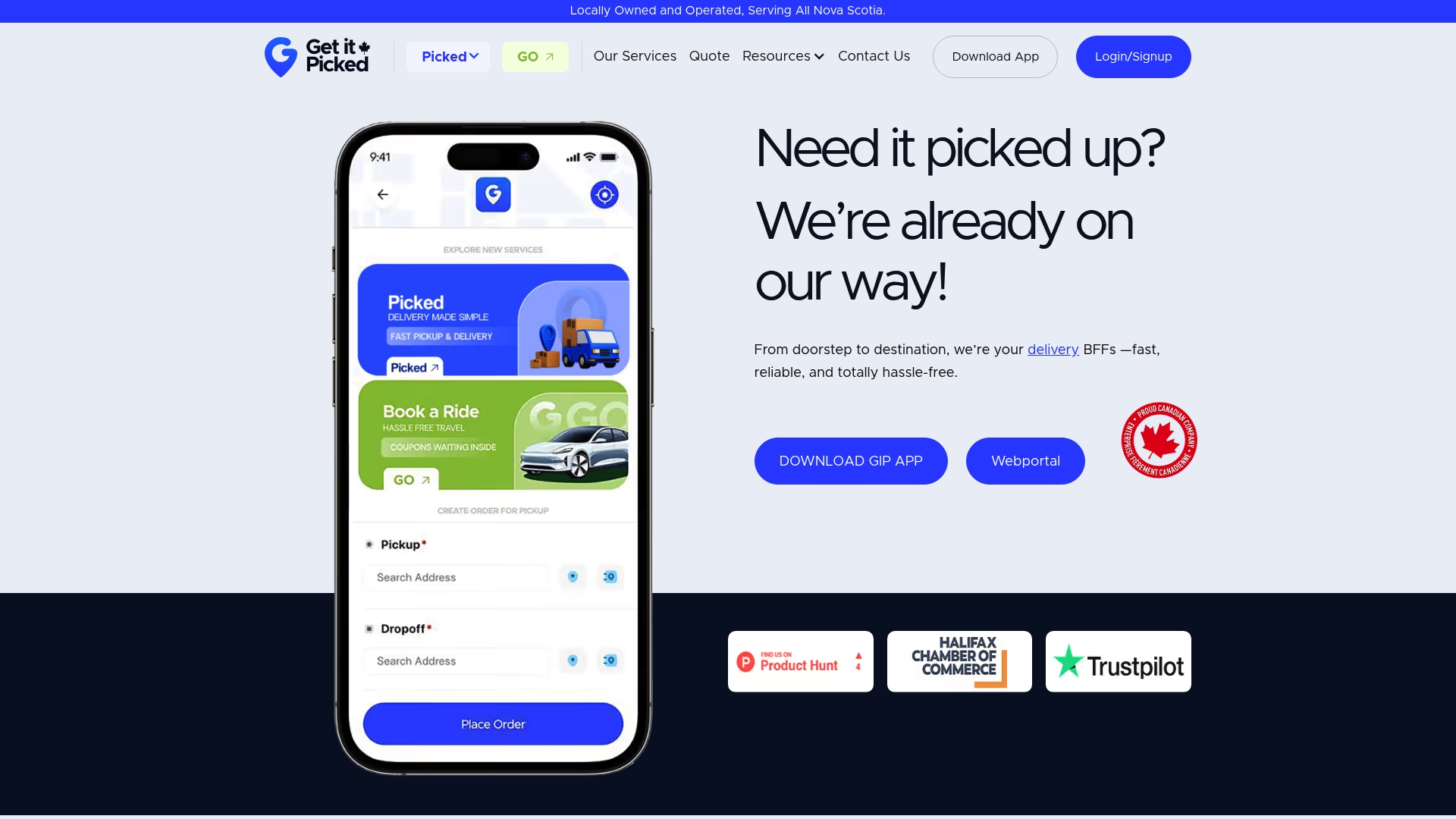
Coverage runs across Nova Scotia, and the same transparent rate structure applies whether you’re an individual booking a one-off pickup or a business setting up recurring same-day routes. Frequent shippers can move beyond one-off pricing entirely. Get It Picked offers volume discounts and B2B contract options for businesses that need predictable same-day business courier service instead of quoting each delivery from scratch, and pairs well with 3PL fulfillment support for merchants managing inventory alongside delivery.
Businesses shipping apparel, print, or promotional goods that depend on fast turnarounds, like custom transfer orders from partners such as Transfer Kingz, often need same-day delivery to close the loop between production and customer.
Check your zone rate or request a business quote through the same-day delivery service page to see exactly what your route costs before you commit to anything.
Where to Verify Live Same-Day Rates
Published rate pages, with clear zone maps and cutoff times, are the fastest way to confirm what you’ll actually pay before you book.
Check retailer fee pages, local courier rate sheets, and the Get It Picked same-day service page directly for current quotes.
Frequently Asked Questions
How much is same-day delivery for a small package?
Expect to pay $5 to $15 for a small item moving a short distance in an urban area, based on typical provider-type pricing bands.
What’s a typical same-day courier price for a business?
Budget a fully-loaded cost of $14 to $22 per order once you include carrier fees, labor, packaging, and platform costs, per Online Store News.
What’s the cost of emergency or rush delivery?
Does prescription delivery cost more than standard same-day delivery?
Prescription and medical supply deliveries often fall within standard same-day pricing bands but may carry a small additional fee for signature confirmation or special handling.
Why do same-day prices vary so much between providers?
Distance, delivery density, urgency window, package size, and included features like tracking and insurance all shift the total, which is why normalizing quotes into one all-in figure matters.
Do volume discounts really lower the price much?
Yes. Businesses committing to regular volume typically unlock a meaningfully lower per-order rate than one-off, no-minimum pricing.
Sources
Recommended