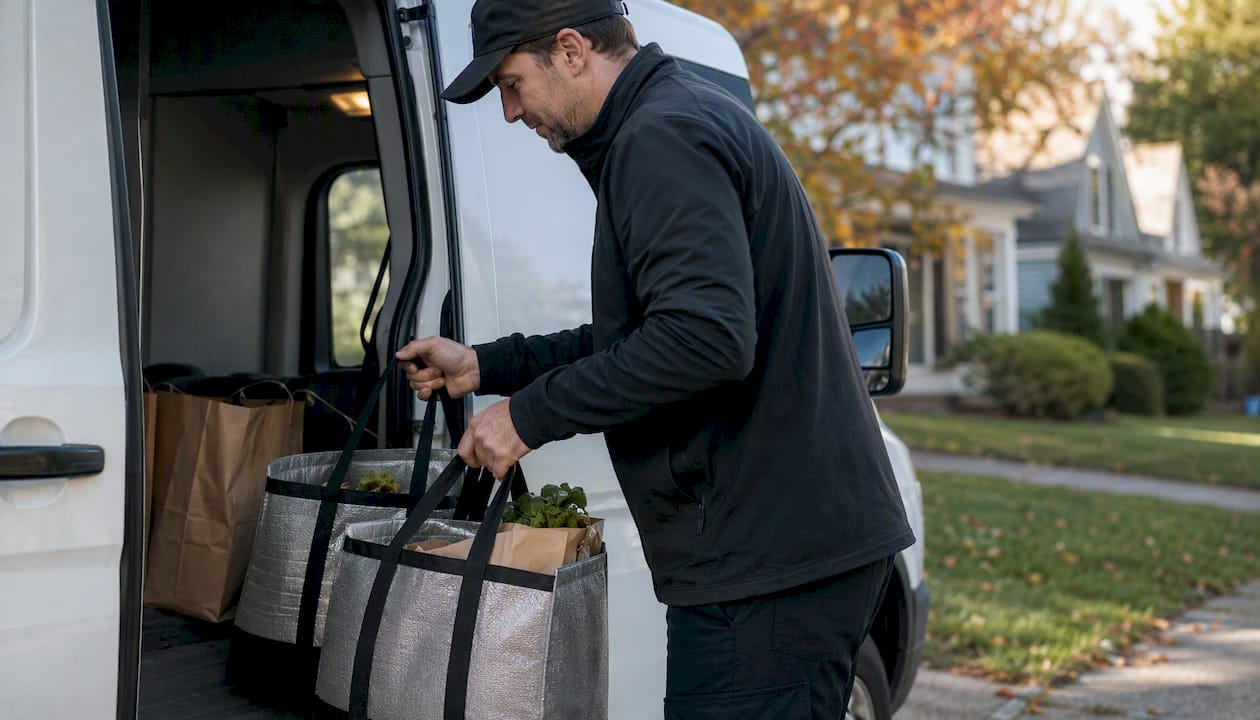
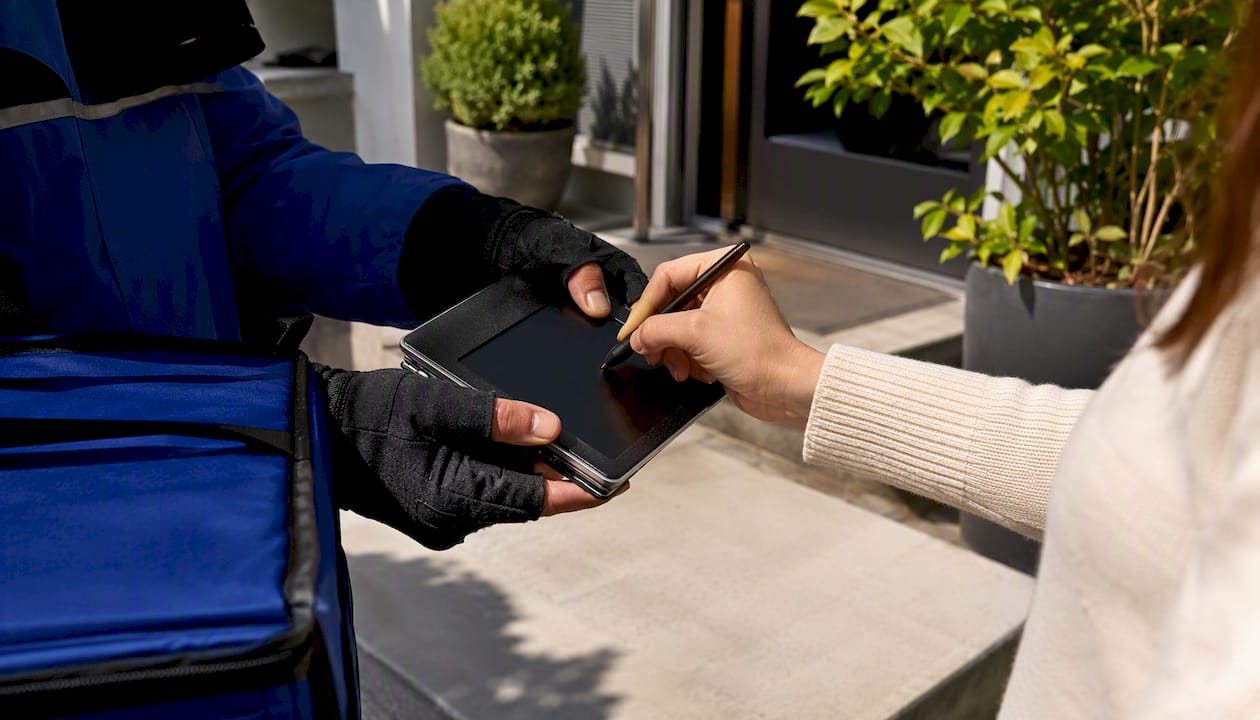
ID verification on delivery is the process of confirming a recipient’s identity and age at the doorstep before handing over restricted or high-value items. Drivers check a government-issued photo ID, scan or record the result, and either complete or refuse the handoff based on what they find.
The practical bottom line:
- When it’s mandatory: Alcohol, prescription medications, tobacco and vape products (governed by the PACT Act), cannabis in legal states, and high-value or flagged orders all commonly require a delivery recipient ID check.
- What counts as evidence: A government-issued photo ID with a scannable barcode or QR code, account-level authentication, or a biometric match tied to enrollment under NIST SP 800-63 standards.
- If verification fails: Refuse the delivery, document the reason, and return the order to the facility. Getitpicked builds this refuse-and-return step directly into its driver workflow.
Key Takeaways
ID verification on delivery requires both enrollment-level identity proofing and doorstep authentication to reliably prevent proxy deliveries and meet U.S. regulatory obligations.
| Point |
Details |
| Mandatory categories |
Alcohol, prescriptions, tobacco/vape (PACT Act), cannabis, and flagged high-value orders all require doorstep ID checks. |
| Verification methods |
Barcode scan plus visual photo check is the practical standard; liveness detection adds fraud resistance for higher-risk deliveries. |
| Refusal protocol |
Refuse delivery, log the reason with timestamp and GPS, and initiate a return flow when verification cannot be completed. |
| Privacy-first storage |
Store attestations (pass/fail, method, timestamp, GPS), not raw ID images; encrypt logs and apply short retention windows. |
| Getitpicked approach |
Getitpicked combines app-based barcode scanning, timestamped attestation logs, and an automatic refuse-and-return protocol for regulated deliveries. |
Table of Contents
Which deliveries legally require an ID check in the U.S.?
Several product categories trigger mandatory secure delivery verification under federal or state law. Knowing which ones apply to your operation is the first step toward compliance.
Common categories that require doorstep ID checks:
- Alcohol: State alcohol control boards set the rules. Most require the driver to confirm the recipient is 21 or older, and many states require a physical ID check rather than account-level attestation alone.
- Prescription medications: Pharmacies and pharmacy benefit managers often require signature plus ID confirmation at delivery, with HIPAA governing what data can be recorded.
- Tobacco and vape products: The PACT Act requires age verification at both checkout and delivery for cigarettes, smokeless tobacco, and electronic nicotine delivery systems. Platforms that only check at the door face growing enforcement risk.
- Cannabis: Legal in a growing number of states, but each state sets its own age verification and documentation rules. No federal standard applies.
- High-value or flagged orders: Merchant policy, insurance requirements, or a flagged account can trigger a delivery-time ID check even when no law requires it.
Platform APIs now reflect this directly. Order schemas commonly include flags like age_verification_on_delivery and id_verification_on_delivery so platforms can require driver-side checks per product category and jurisdiction.
Liability for a missed check typically falls on both the platform and the driver. Shared responsibility is the growing norm, and regulators have shown willingness to pursue platforms, not just individual couriers.
Key regulatory shift: Regulators are moving toward multi-point verification for high-risk categories, expecting checks at both checkout and delivery. A platform that only verifies at the door is increasingly exposed under laws like the PACT Act.
How drivers actually confirm ID and age at the door
Several methods are in active use across U.S. delivery platforms. Each has real strengths and real limits.
| Method |
Speed |
Fraud resistance |
Best for |
Common failure modes |
| Visual photo check |
Fast |
Low |
Low-risk fallback |
Human error, altered IDs |
| Barcode/PDF417 scan |
Fast |
Medium |
Age verification |
Damaged barcodes, poor lighting |
| Mobile document scan |
Medium |
High |
Identity + age |
Low-quality cameras, glare |
| Facial match + liveness |
Slower |
Very high |
IAL2/IAL3 compliance |
Connectivity, user friction |
| Account OTP/push auth |
Fast |
Medium-high |
Returning verified users |
SIM swap, shared accounts |
| Signature capture |
Fast |
Low |
Proof of receipt |
No identity confirmation |
| Timestamped GPS log |
Passive |
High (audit) |
All regulated deliveries |
Not a standalone check |
Uber’s delivery developer documentation confirms that drivers are commonly required to photograph or scan a government-issued photo ID at drop-off. When a check cannot be completed, a return trip is initiated.
Driver apps like those used in the industry scan the barcode on the back of a U.S. driver’s license to auto-populate and verify age, with a manual fallback for damaged or unreadable IDs. That fallback matters: a driver who skips verification because a barcode won’t scan creates an audit gap.
Practical limits to plan around:
- Barcode scanning fails on worn, laminated, or wet IDs.
- Liveness detection requires a stable connection and adds 15–30 seconds per handoff.
- Fraudulent IDs with valid barcodes can pass a scan-only check without a visual comparison.
Pro Tip: Combine automated barcode scanning with a mandatory visual photo comparison as a fallback. This keeps most handoffs fast while closing the gap that scan-only flows leave open.
Identity proofing versus authentication: why both matter
These two processes are often confused, but they serve different purposes in a compliant delivery operation.
Identity proofing happens at enrollment. It’s the process of resolving who a person is, validating their documents, and verifying that the person presenting the documents is the same person the account belongs to. NIST SP 800-63A defines three Identity Assurance Levels (IAL1–IAL3). IAL2 requires physical or biometric comparison; IAL3 requires in-person proofing. Knowledge-based verification (security questions) is explicitly weak for binding a person to a doorstep delivery.
Identity authentication happens at every delivery handoff. It confirms that the person at the door is the same person who was proofed at enrollment.
Socure’s identity verification glossary draws this distinction clearly: proofing is an enrollment-level event; authentication is an ongoing confirmation. A layered approach using both reduces fraud more than either alone.
When to use each:
- Account-level IAL2/IAL3 proofing: at signup for platforms handling regulated goods, or when a customer first orders a restricted category.
- Delivery-time authentication: OTP, driver barcode scan, or biometric match at every regulated handoff.
- Avoid relying on onboarding checks alone. Veriff’s research on last-mile delivery shows that operators who skip doorstep authentication see more proxy deliveries and last-mile fraud.
Pro Tip: Treat proofing and authentication as two separate controls, not one. Proofing tells you who the account belongs to. Authentication tells you who is standing at the door right now.
Step-by-step driver workflow and refusal protocol
A compliant handoff follows a defined sequence. Skipping steps creates liability.
Compliant delivery handoff:
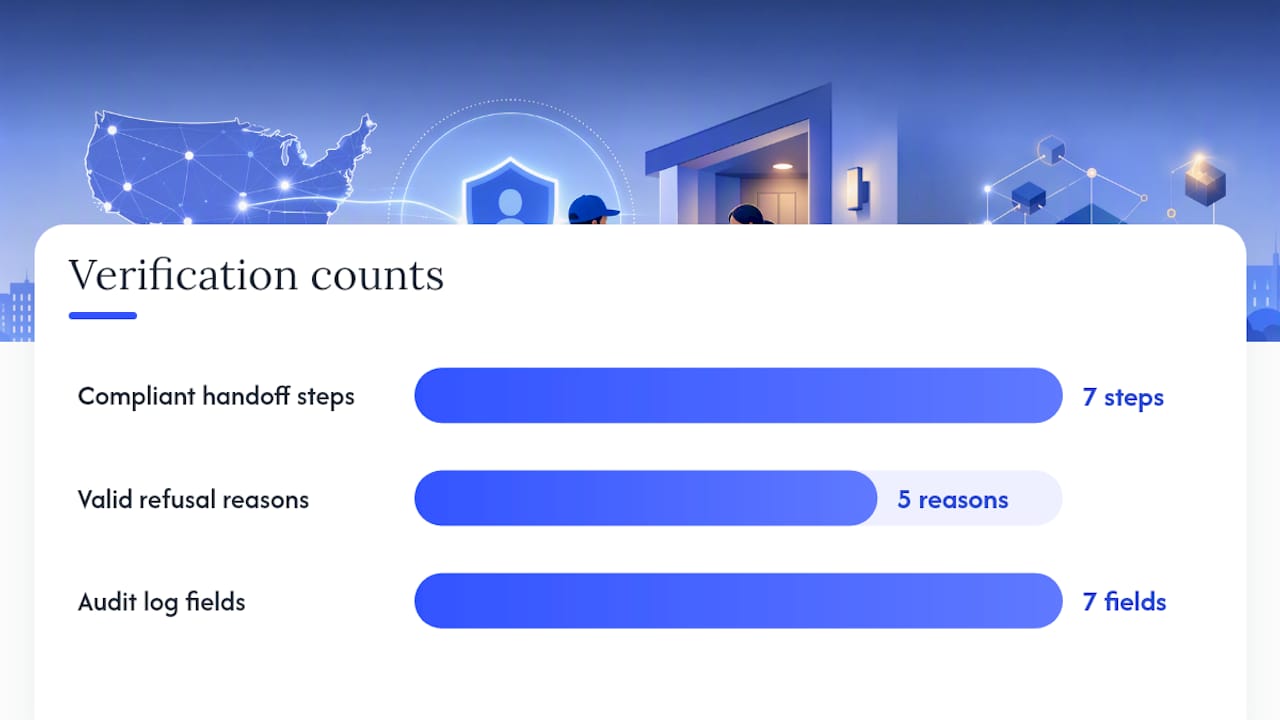
- Arrive at the address and confirm the order requires ID verification via the app prompt.
- Ask the recipient for a government-issued photo ID before handing over the package.
- Visually compare the photo, name, and date of birth on the ID to the person at the door.
- Scan the barcode on the back of the ID using the driver app; use manual entry as a fallback if the scan fails.
- Capture a timestamped GPS log and record the verification result (pass/fail, method used).
- Collect a signature if the platform or merchant requires it.
- Complete the handoff or initiate the refusal protocol.
Refusal protocol:
- Valid refusal reasons: ID is expired, name doesn’t match the account, recipient appears underage, recipient appears intoxicated, a third party answers the door and cannot provide a matching ID.
- Immediate action: Cancel the delivery in the app, mark the reason, and begin the return flow.
- Documentation: Record the refusal reason and verification method in the app log. Do not photograph the recipient’s ID without explicit platform authorization and a lawful basis.
- Escalation: Notify dispatch or a supervisor for any disputed refusal.
Audit log fields that regulators and platforms expect: timestamp, driver ID, delivery address, verification method used, result (pass/fail), GPS coordinates, and order ID.
Pro Tip: Build the refusal flow into the app so drivers cannot mark a delivery complete without logging a verification result. An unclosed verification step is an audit failure.
Privacy, data retention, and legal guardrails for ID data
Storing ID data creates risk. The goal is to keep what you need for compliance and nothing more.
Privacy principles for operators:
- Store verification attestations (pass/fail, method, timestamp, GPS, driver ID), not raw ID images.
- Encrypt all logs in transit and at rest.
- Set short retention windows for any sensitive artifacts. Most audit needs are satisfied by a 90-day attestation log.
- Prefer attestation-only outputs from your verification vendor rather than full document images.
Legal considerations:
- HIPAA: Prescription deliveries involve protected health information. Any verification record tied to a prescription must be handled under HIPAA’s minimum-necessary standard.
- State privacy laws: California’s CPRA and similar state frameworks may classify ID data as sensitive personal information, triggering additional consent and deletion rights.
- Raw ID image storage: High-risk. A breach of stored ID images creates significant liability. Store only if a lawful business need exists and secure controls are in place.
Pro Tip: Export audit logs in a structured format (CSV or JSON) so you can respond to a regulatory request within hours, not days. A log you cannot export quickly is nearly as bad as no log at all.
How to choose and integrate delivery-time ID verification technology
A vendor-neutral checklist keeps your selection grounded in operational reality rather than marketing claims.
Feature checklist for any verification tool:
- Document-authentication accuracy across U.S. state ID formats
- Liveness detection for remote facial comparison
- PDF417 barcode parsing with a manual fallback
- Mobile SDK reliability on mid-range Android and iOS devices
- Attestation-only output mode (no raw PII retained by the vendor)
- Exportable audit logs with timestamp and GPS fields
- Configurable per-jurisdiction and per-product rules
- Sub-10-second response time for barcode scans
- Offline fallback for low-connectivity delivery zones
Implementation approach:
Start with account-level verification at signup for regulated categories. Then add configurable, driver-prompted checks for products that still legally require a doorstep confirmation. Pilot with a small driver cohort, measure verification completion rates and average handoff time, and tune the UX before a full rollout.
The on-demand delivery model creates specific integration pressure: verification must be faster than a signature capture or drivers will skip it. If your current verification step takes longer than signing a screen, adoption will drop.
Pro Tip: Pair phone-based document scanning with backend device intelligence (account linking, device fingerprinting) to block ghost-driver and synthetic-identity fraud that document checks alone won’t catch.
How Getitpicked runs ID checks in practice
Getitpicked’s same-day delivery operations combine account-level verification for regulated customers with a driver app scan at the point of handoff. Every regulated delivery generates a timestamped, GPS-tagged attestation log. Raw ID images are not retained beyond the immediate verification window.
When a driver cannot complete a check, the refuse-and-return protocol activates automatically in the app. The driver logs the refusal reason, dispatch is notified, and the order enters the reverse logistics flow for return processing.
Operational principle: The verification step in the Getitpicked driver app is designed to take less time than a signature capture. If verification adds friction beyond that threshold, driver compliance drops and the audit trail breaks down.
What this looks like in practice:
- Regulated order flagged at checkout via order schema rules.
- Driver prompted at arrival to request ID before package handoff.
- Barcode scan auto-populates age and name; visual check confirms photo match.
- Attestation logged with timestamp, GPS, driver ID, and result.
- Refusal triggers an automatic return flow with a logged reason.
Pro Tip: Make verification faster than your current signature step. Speed is what keeps drivers compliant on high-volume days.
Recipient checklist for a smooth ID verification at delivery
Preparation on the recipient’s side prevents failed deliveries and repeat trips.
Before the driver arrives:
- Have a valid, government-issued photo ID ready at the door (driver’s license, state ID, or passport).
- Make sure the account holder, not a proxy, is present to receive the order.
- Check that your ID is not expired. Many platforms reject IDs expired more than 30 days prior.
- Be in a well-lit area so the driver can read the ID clearly and the app camera can scan the barcode.
- Be prepared to sign if the platform or merchant requires it.
IDs typically accepted: U.S. driver’s license, state-issued ID card, U.S. passport or passport card, and military ID. Digital images or screenshots of IDs are often rejected by driver apps that require a physical barcode scan.
Businesses sending regulated goods should communicate verification requirements at checkout and in the pre-delivery notification. A single line in the confirmation email (“Please have a valid photo ID ready at the door”) reduces failed first-attempt deliveries.
Why layering proofing and doorstep authentication is the right approach
The conventional wisdom in delivery operations is that onboarding verification is enough. It isn’t. An account that was properly proofed at signup can still be used by someone else at the door. Proxy deliveries, shared accounts, and stolen credentials all exploit the gap between who enrolled and who actually receives the package.
Layering account-level proofing with delivery-time authentication closes that gap. The audit trail becomes cleaner, regulatory exposure drops, and disputed deliveries are easier to resolve because the evidence exists. Operators who measure verification completion rates and refusal rates as KPIs tend to catch compliance gaps before regulators do.
The upfront cost of building both layers is real. But the cost of a single PACT Act enforcement action, a pharmacy board complaint, or a liability claim from an underage alcohol delivery is substantially higher. The math favors the layered approach.
Getitpicked handles regulated deliveries so you don’t have to guess
Regulated deliveries, whether prescriptions, alcohol, or age-restricted goods, carry real legal exposure when ID checks are missed. Getitpicked’s same-day delivery service is built with compliant handoff workflows from the start: driver app prompts, barcode scanning, timestamped attestation logs, and a defined refuse-and-return protocol for every regulated order.
For businesses managing ecommerce or 3PL fulfillment, Getitpicked’s ecommerce integration connects order-level verification flags directly to driver workflows, so the right check happens automatically for the right product. No manual configuration per order. Request a quote or check service availability for your delivery category today.
Sources
Recommended