A delivery window is a scheduled time range during which a shipment is expected to arrive, such as 10:00 AM–12:00 PM or 2:00 PM–5:00 PM. According to the Delivery Window Glossary, it is a range, not a guaranteed single-minute arrival. That distinction matters for everyone involved.
Why delivery windows matter:
- Predictability: Both the recipient and the carrier know when to be ready, which cuts missed deliveries and wasted trips.
- Route planning: Carriers use windows to batch stops efficiently, keeping costs down and delivery times fast.
- Measurable reliability: Industry KPIs like OTIF (On Time In Full), window adherence, and first-attempt delivery rate (FADR) all depend on a defined window to measure against.
Key Takeaways
A delivery window is a scheduled time range, not a guaranteed minute, and its width reflects the carrier’s routing capability and service design more than any single external factor.
| Point |
Details |
| Definition |
A delivery window is a scheduled time range (e.g., 2–5 PM), not a guaranteed arrival minute. |
| Window vs. ETA |
The window is the confirmed slot; the ETA is the live prediction that moves within it. |
| Width by industry |
Same-day couriers offer 1–2 hour slots; movers use multi-day spread dates. |
| Key reliability KPIs |
Window adherence, OTIF, FADR, and delivery exception rate are key KPIs used to measure delivery reliability and performance. |
| Top action for recipients |
Choose the narrowest slot available and sign up for real-time carrier notifications. |
| Top action for businesses |
Validate capacity before confirming a window to avoid over-promising and missed deliveries. |
Table of Contents
What does delivery window mean, and how does it differ from an ETA?
A delivery window is a pre-confirmed scheduled slot, for example “between 2:00 PM and 5:00 PM on Thursday.” The carrier commits to that range when the order is booked or routed. Common alternative terms include:
- Delivery slot: Used most often in e-commerce checkout flows where customers pick a preferred time.
- Appointment window: Common in white-glove, furniture, and medical-supply deliveries where someone must be present.
- Delivery time window: A broader term used in logistics software and carrier help pages.
- Spread dates: A multi-day range used by long-distance movers (for example, December 15–18), reflecting transit variability rather than a single-day commitment.
An ETA is different. Where a window is a fixed scheduled range, an ETA is a live, moving prediction. Your window might say 2:00–5:00 PM; your ETA at 3:45 PM might say “arriving in 12 minutes.” The SmartRoutes glossary describes this well: the window is the contractual slot, while the ETA is the real-time estimate that shifts inside, or occasionally outside, that slot as conditions change. Tracking both gives recipients the clearest picture of when to actually be home.
How long are delivery windows across different industries?
Window length varies widely depending on service type, route complexity, and how much technology the carrier uses. Here is how it typically breaks down:
- Same-day courier (1–2 hours): A local same-day service can offer a tight 1–2 hour slot because the route is short and the driver is dispatched in real time. Same-day business courier services in Nova Scotia operate this way, with narrow windows built around live routing.
- E-commerce standard (2–4 hours or end-of-day): Most online retailers offer either a morning/afternoon block or a full-day window. Locus that customer-selectable slots at checkout are common for standard and same-day e-commerce orders.
- Freight and LTL carriers (full day or AM/PM block): Shared-truck models mean the carrier cannot guarantee a narrow slot. A full-day or AM/PM window is standard.
- Long-distance movers (multi-day spread): Transit time, weather, and shared loads make a single-day commitment unrealistic. A spread of December 15–18 is typical. NTS Logistics explains that freight and moving windows stay broad because of these compounding variables. Proper self-storage staging can help households stay flexible when a mover’s spread dates shift.
- White-glove and medical supply (scheduled appointment): These require a confirmed appointment window, often 2–4 hours, because assembly, installation, or a signature is needed on arrival.
The I’d Ship That glossary identifies five common window types: standard day range, day-definite, commitment/by end of day, AM delivery, and scheduled hour range. Knowing which type applies to your shipment sets the right expectation from the start.
What factors make delivery windows wider or narrower?
Window width is not arbitrary. Several forces push it in one direction or the other.
External factors include traffic congestion, weather, road construction, and seasonal demand spikes. A carrier running 40 stops on a clear Tuesday can promise a 2-hour slot. The same route during a snowstorm or a holiday peak becomes a 4-hour window or wider.
Internal factors are often more controllable. Route density (how many stops are clustered together), driver staffing levels, fulfillment processing time, and loading delays all affect how confidently a carrier can commit to a narrow slot. A sparse rural route with few stops will always carry a wider window than a dense urban cluster.
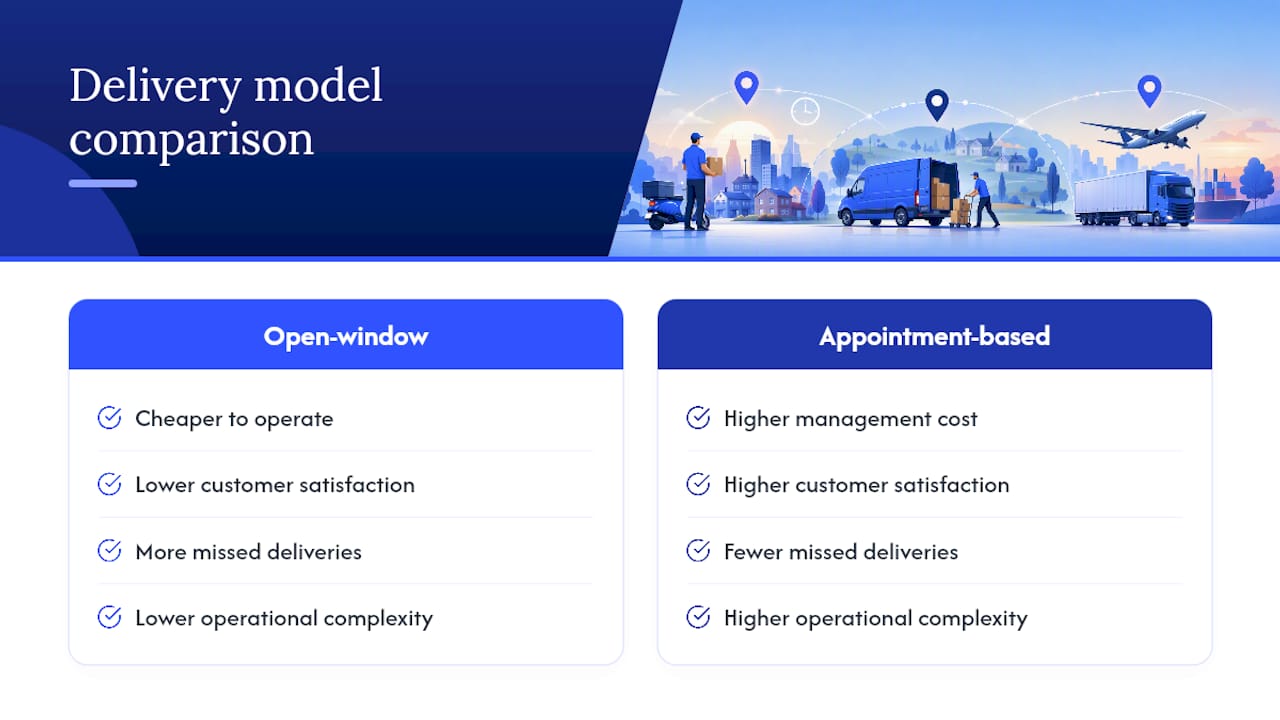
Service design also plays a role. Open-window models, where the carrier delivers anytime during business hours, are cheaper to operate but frustrating for recipients. Appointment-based models cost more to manage but produce far fewer missed deliveries and redelivery fees.
Pro Tip: If you are a business setting windows, audit your fulfillment cut-off time first. A 2-hour delivery window that starts before the warehouse has finished picking the order is a promise you cannot keep.
How do businesses set and optimize delivery windows?
The mechanics follow a clear sequence: a delivery request comes in, the system checks available capacity and driver location, the route is assigned, and a confirmed window is sent to the customer. Where that process breaks down, missed windows and customer complaints follow.
Modern carriers are shifting from static scheduling to real-time routing platforms that recalculate routes dynamically as conditions change. Fleet telematics, dynamic ETA engines, and capacity-aware booking tools let operations teams move from broad day-long windows to tight 1–2 hour slots without adding drivers.

The ITEM glossary identifies key KPIs that measure whether windows are reliable or just optimistic, including window adherence, OTIF, delivery exception rate, and first-attempt delivery rate (FADR). Benchmarks for these KPIs vary across operations.
Practical optimization tactics include batching deliveries by zone, using capacity-aware booking that blocks new slots when a route is full, and building real-time re-routing into the dispatch workflow. Businesses managing 3PL fulfillment can also reduce window width by staging inventory closer to the delivery zone, cutting the time between order release and pickup.
Pro Tip: Validate capacity before confirming a slot. Confirming a window before checking driver availability is the single fastest way to inflate your exception rate.
Supply-chain analysts at Gartner consistently flag last-mile routing technology as the core lever for improving delivery-window accuracy at scale.
Practical steps for recipients and businesses managing delivery windows
For recipients:
- Choose the narrowest slot your schedule allows at checkout. A 2-hour window is easier to plan around than a full-day one.
- Sign up for carrier notifications (SMS or app alerts) so you get a live ETA as the driver approaches.
- If you cannot be home, designate a secure drop spot or authorize a neighbor. Many carriers accept written drop-off instructions.
- Reschedule early. Most carriers allow free rescheduling up to a cutoff, usually the evening before. Waiting until the morning of the delivery often locks the route.
- Use a precise address format, including unit numbers and gate codes, so the driver does not lose time locating the drop point.
For businesses and shippers:
- Set realistic windows based on actual route capacity, not marketing targets.
- Send proactive notifications at booking confirmation, the day before, and when the driver is 30 minutes out.
- Offer a paid narrow-window upgrade for customers who need certainty. Many will pay a small premium for a 1-hour slot.
- Track FADR and window adherence weekly. A drop in either metric is an early signal of a routing or capacity problem.
- For time-sensitive deliveries like legal documents or prescriptions, use a same-day delivery service built for narrow windows rather than a standard courier.
Pro Tip: For small shippers, include a photo of the building entrance or a landmark in your delivery notes. Drivers in dense urban areas lose minutes per stop on address confusion, and that adds up across a full route.
Why the narrowest window is not always the best window
There is a common assumption that tighter windows always mean better service. From an operator’s perspective, that is only half true.
A 1-hour window requires precise route sequencing, real-time traffic data, and a driver who has no buffer for a difficult parking situation or a customer who takes five minutes to answer the door. When those conditions are not met, a 1-hour window fails more visibly than a 3-hour window would. The KPIs discussed earlier, particularly window adherence and FADR, exist precisely because narrow windows carry higher failure risk when the back-end systems are not ready to support them.
Customers remember the miss, not the ambition.
Sources
Recommended